
7 Reasons Ingredient Transparency Matters for Sensitive Skin
Last Updated: October 27, 2026
Quick Summary
Ingredient transparency matters because it lets you check exactly what is in a product in plain terms, which is especially useful if your skin is sensitive. In the United States, federal labeling rules require ingredients to be listed in descending order of concentration, but fragrance can legally appear as a single word without naming the compounds inside it. Transparency is really a reader skill: the label only helps you if you know what you are looking at.
- Ingredients must be listed in descending order of concentration, with low-level ingredients allowed in any order after the main ones.
- Fragrance and flavor may legally appear as those single words, so a label can say fragrance without naming the compounds inside.
- Scan the first five ingredients first, since they make up the bulk of the formula.
- Unscented usually means a masking fragrance was added, while fragrance-free means no scent was added at all.
- Check the full ingredient list on the product page before buying, not just the front-label claims.
Table of Contents
- Why Ingredient Transparency Matters for Skin
- What Cosmetic Ingredient Disclosure Actually Requires
- How to Read Skincare Ingredient Labels Step by Step
- Fragrance-Free vs. Unscented Skincare: What the Label Really Says
- Common Skincare Irritants to Recognize on a Label
- How to Verify Ingredient Claims Beyond the Front Label
- Where Transparency Has Limits, and Why That Matters
- Patch Testing and Choosing Products for Your Skin
- Frequently Asked Questions
Why Ingredient Transparency Matters for Skin
Ingredient transparency means a brand tells you exactly what is in a product, in plain terms you can check. It can be useful when you want to check a product’s ingredients, especially if your skin is sensitive.
At Lotus Beauty Co., we built our entire line around that idea. Every formula is fragrance-free, and every ingredient is listed and explained. But transparency is not a marketing badge. It is a practical tool you can use in any store, on any label. Below, we walk through what the law actually requires, how to read a label, and where even honest brands hit limits.
One thing most guides get wrong: they treat transparency as a brand virtue. It is really a reader skill. The label only helps you if you know what you are looking at.
What Cosmetic Ingredient Disclosure Actually Requires
Cosmetic ingredient disclosure is the legal duty of a brand to list its ingredients on the product label. In the United States, that duty comes from federal labeling rules, not from a brand's goodwill.
What the FDA Requires on a Skincare Label
The FDA's cosmetic labeling requirements set the baseline. Ingredients must be listed in descending order of concentration, with those present at low levels allowed to appear in any order after the main ones. Fragrance and flavor are permitted to appear as those single words, which means a label can legally say "fragrance" without naming the dozens of compounds inside it.
That is the gap that matters for sensitive skin. The law gives you a list. It does not give you a full breakdown of every scent molecule.
Where Labeling Rules Stop and Brand Choices Begin
Federal rules cover what must appear. They do not cover how clearly a brand explains it.
A brand can meet the letter of the law and still leave you guessing. It can print a dense ingredient list in tiny type, bury an explanation in fine print, or lean on front-label words like "gentle" and "clean" that carry no legal definition. Everything beyond the required list is a choice.
We made a different choice. Our ingredient transparency approach explains what goes into each formula.
How to Read Skincare Ingredient Labels Step by Step
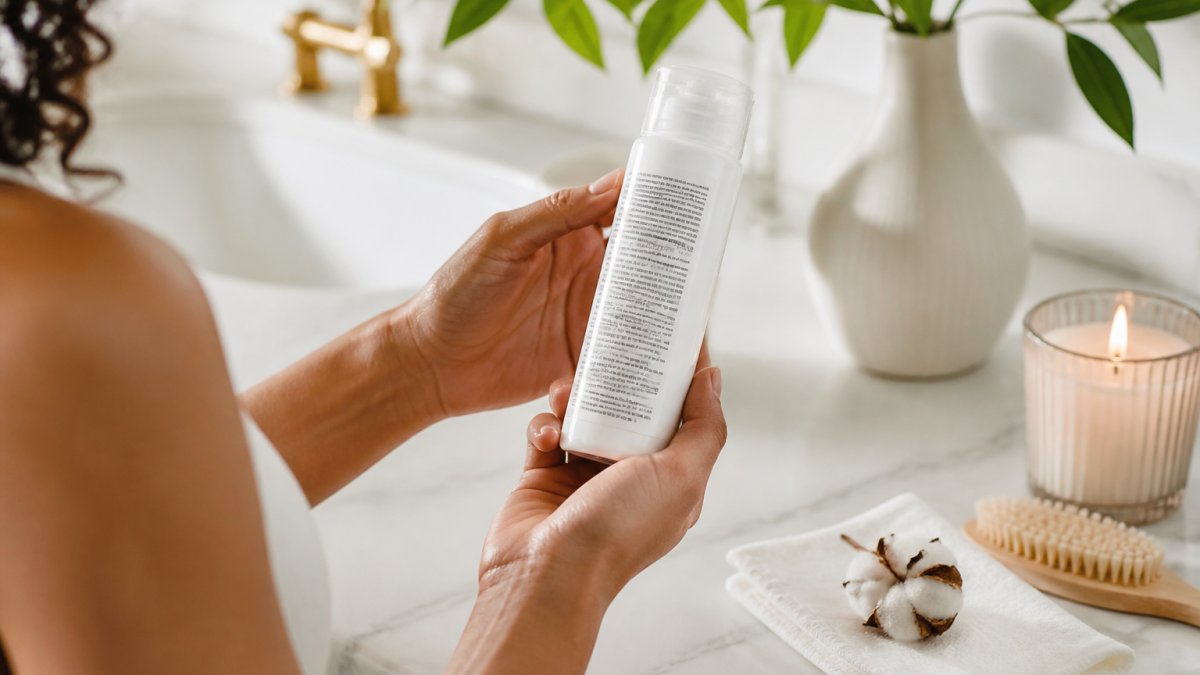
Reading a skincare ingredient label takes practice. Start with the ingredient list, then check the front claims.
Here is the sequence we suggest:
- Find the word "fragrance" or "parfum." If it appears, the product contains a scent blend the label does not fully name.
- Scan the first five ingredients. These make up the bulk of the formula. If alcohol or a strong acid sits near the top, note it.
- Look for dyes, often listed as CI numbers or "FD&C" colors.
- Check preservatives. Every water-based product needs them. Their presence is normal; their absence in a water-based cream is a red flag.
- Read the back claims last, after you have seen the list. The list tells you more than the front of the bottle.
What Is an INCI List, and Why Does It Look Like That?
An INCI list uses standardized ingredient names printed on a label.
A few conventions help you translate:
A Worked Example: Reading a Label Top to Bottom
Imagine a moisturizer whose list begins: Water, Glycerin, Caprylic/Capric Triglyceride, Cetearyl Alcohol, Butyrospermum Parkii (Shea) Butter, Sodium Hyaluronate, Tocopherol, Phenoxyethanol, Fragrance.
Here is how to read it:
- Water and glycerin lead, so this is a water-based, humectant-rich formula. That is typical for a daily cream.
- Caprylic/capric triglyceride and shea butter are emollients, the ingredients that give a cream its slip and cushion.
- Cetearyl alcohol is a fatty alcohol used to thicken. It is not the same as "alcohol denat." or "SD alcohol," which are the drying types.
- Sodium hyaluronate is a humectant that helps skin hold water.
- Tocopherol is vitamin E, often used to help protect a formula from oxidation.
- Phenoxyethanol is a preservative. Its presence in a water-based product is expected.
- Fragrance at the end means a scent blend is present, even though it sits low in the list.
That single pass tells you the product's texture, its main jobs, whether it is preserved, and whether a scent blend is present. You did not need a chemistry degree. You needed the order of operations and a few naming conventions.
A Simple Checklist for Your Next Product Label
- Is "fragrance" or "parfum" listed anywhere?
- Are the first five ingredients ones your skin has tolerated before?
- Do you see dyes, or CI numbers you do not recognize?
- Does the brand explain its ingredients somewhere beyond the bottle?
- Is there a clear statement of what the product is for?
- Can you find a full ingredient list before you buy?
If you want a complete, browsable reference for what each ingredient does, our ingredient index lists every one we use, from A to Z, so you can look things up at your own pace.
Fragrance-Free vs. Unscented Skincare: What the Label Really Says
Fragrance-free and unscented are not the same thing, and the difference matters for reactive skin. "Unscented" usually means a product contains a masking fragrance to cover the smell of its raw ingredients. "Fragrance-free" means no scent has been added at all.
A product labeled unscented may still contain fragrance. Check the ingredient list for details.
For anyone with sensitive or treatment-affected skin, fragrance-free may be a preference to consider. If you want the full breakdown of how these two terms differ, we cover it in our guide to fragrance-free versus unscented skincare.
Common Skincare Irritants to Recognize on a Label
Ingredients can affect people differently. Reading the label can help you identify ingredients you may wish to ask your care team about.
Here is how they tend to appear:
| What to Look For | How It Appears on a Label | Why It Matters for Sensitive Skin |
|---|---|---|
| Added scent | "Fragrance," "parfum" | A top cause of contact reactions |
| Essential oils | Lavender oil, citrus peel oil | Natural, but still a scent compound |
| Drying alcohol | Alcohol denat., SD alcohol | Can leave skin feeling tight |
| Dyes | CI numbers, FD&C colors | Added for appearance, not the skin |
| Harsh surfactants | Some sulfates | Can strip the skin barrier |
Presence Is Not the Same as Risk: Why Dose and Formulation Matter
An ingredient's presence on a label does not by itself establish how your skin will respond.
A few principles help you keep perspective:
Reading labels can help you understand what a product contains.
"Natural" Does Not Mean "Non-Irritating"
One honest note: "natural" does not mean "non-irritating." The label tells you what is there. Your skin tells you how it responds.
If you are in active treatment, your care team knows your skin and your history. Ask them before adding anything new, especially on skin that has had radiation.
How to Verify Ingredient Claims Beyond the Front Label
Verifying an ingredient claim can include checking the full ingredient list, the brand's ingredient education, and the product page.
Try this:
- Search the product page for a full list, not a highlights reel.
- Look for a dedicated ingredient page that explains each one.
- Check whether the brand names what is absent, such as fragrance or dyes, and whether that matches the list.
- Ask directly if something is unclear. A brand confident in its formula will answer.
We publish our full ingredient index for exactly this reason. You should not have to take our word for it. You should be able to look.
Where Transparency Has Limits, and Why That Matters
Transparency has real limits, and pretending otherwise would undercut the whole point. Three limits are worth knowing.
First, a label may use the word "fragrance" without naming each component of a blend.
Second, a list does not tell you how your skin will respond.
Third, no label replaces medical advice. If you are in active treatment, your care team knows your skin and your history. Ask them before adding anything new, especially on skin that has had radiation.
We would rather tell you these limits plainly than promise more than a label can deliver.
Patch Testing and Choosing Products for Your Skin
Patch testing is the practice of applying a small amount of a new product to a small area of skin and watching for a reaction before using it more widely. Ask your care team whether patch testing is appropriate for you, especially during treatment.
When you are ready to build a routine, start simple. If you would like a ready-made place to begin, our sensitive skincare routine for chemo or radiation pairs a morning and night moisturizer for dry, sensitive skin. If you would rather browse first, you can explore our fragrance-free products for sensitive skin at your own pace.
Our Awaken Day Cream is a fragrance-free daily moisturizer for dry, sensitive, and stressed skin. Our Restore Night Cream is a fragrance-free nighttime moisturizer for dry, sensitive, and treatment-affected skin. Ask your care team about individual needs during treatment.


Frequently Asked Questions
Why does ingredient transparency matter in skincare?
Ingredient transparency gives you information about what is in a product, which can be useful when your skin is sensitive or changing during treatment. A full ingredient list lets you review the listed ingredients. Transparency can make a label more useful to you.
What does fragrance-free mean on a skincare label?
Lotus Beauty Co. products are fragrance-free. If you are comparing labels, review the ingredient list and ask the brand if anything is unclear.
Can skincare ingredients irritate sensitive skin?
Skin responses to products can vary. If you are considering a new product during cancer treatment, check with your oncology or dermatology care team before using it.
How can I choose skincare during cancer treatment?
Start by asking your care team about your individual needs, especially for skin that has had radiation. Lotus Beauty Co. offers fragrance-free, dermatologist-tested products and an Ingredient Index. Your oncology team can advise you about using new products during treatment.
Sensitive skin asks a lot of the products you put on it, and it deserves a label you can actually read. Lotus Beauty Co. was built for that: fragrance-free formulas, a full ingredient index you can search, and advisors who review what we make. Start with our skincare collection and give your skin something simple, honest, and gentle to rely on.
