
Squalane for Dry Sensitive Skin: A Guide
Table of Contents
- What Squalane Is and Why Dry, Sensitive Skin Tolerates It Well
- How Squalane Supports Dry Skin and the Moisture Barrier
- Why Sensitive and Reactive Skin Often Does Well With Squalane
- How to Layer Facial Oils and Squalane With Your Routine
- Fragrance-Free Skincare Benefits for Reactive Skin
- How to Choose a Squalane Product and Patch Test It
- Conclusion
- Frequently Asked Questions
Last Updated: September 11, 2026
What Squalane Is and Why Dry, Sensitive Skin Tolerates It Well
Squalane is a lightweight, plant-derived oil that mimics the lipids your skin produces naturally, which is why squalane for dry sensitive skin rarely triggers the stinging or redness heavier oils can. It is a saturated hydrocarbon, so it stays stable over time.
That stability matters for reactive skin. Oils high in unsaturated fatty acids can oxidize and turn irritating; squalane does not. It absorbs quickly and behaves more like a replenishing emollient than a coating.
At Lotus Beauty Co., we hear from women in active treatment whose skin has become unpredictable almost overnight. Squalane is often one of the first ingredients that feels tolerable again, because it supports the moisture barrier without asking much in return.
Squalane vs Squalene: What's the Difference?
The two words differ by a single letter and a great deal of chemistry. Squalene is the unsaturated lipid your sebaceous glands produce naturally (peer-reviewed research). Squalane is the saturated, shelf-stable version used in skincare, created by adding hydrogen to squalene so it resists oxidation.
Historically, squalane came from shark liver oil. Today most is plant-derived, commonly from sugarcane, olives, or other botanical sources, which avoids the ethical concerns attached to the animal source.
How Squalane Supports Dry Skin and the Moisture Barrier
Squalane sits in the spaces between skin cells and helps slow transepidermal water loss, the steady evaporation of moisture through the outer layer (PubMed). Your barrier is built from fats, and when it thins, water escapes faster.
What it does not do is add water. That is a hydrating ingredient's job. Squalane helps hold onto the water already there, which is why it pairs so well with humectants.
A few things squalane does well for dry skin:
- Softens rough texture and flakiness over time
- Supports skin elasticity by keeping the barrier supple
- Eases the tight, drawn feeling that follows cleansing
- Layers without pilling under sunscreen or makeup
Is Squalane Moisturizing or Hydrating?
Squalane is moisturizing, not hydrating. Moisturizing means sealing moisture in; hydrating means drawing water into the skin. Squalane is an emollient and light occlusive, so it does the sealing work.
That distinction shapes how you use it. If your skin is dehydrated and tight, apply a humectant first, then squalane on top to lock it in. If your skin is simply dry and depleted, squalane alone can bring real comfort.
Why Sensitive and Reactive Skin Often Does Well With Squalane
Reactive skin usually struggles with two things: ingredients that provoke a response, and a barrier too weak to buffer them. Squalane's short ingredient profile and sebum mimicry address both. It resembles what your skin already makes, so there is less for a sensitized system to reject.
Squalane also has properties that can help support skin comfort. It is not a treatment for any condition, but it is a gentle supporting player. It is also generally considered non-comedogenic, meaning it is unlikely to clog pores, which matters if you deal with congestion alongside dryness (PubMed).
If you are in active treatment or managing a diagnosed skin condition, check with your oncology or dermatology care team before adding anything new. They know your situation in a way no article can.
How to Layer Facial Oils and Squalane With Your Routine
Knowing how to layer facial oils is the difference between a product that works and one that sits on top of your skin doing nothing. The rule is simple: thinnest to thickest, water-based before oil-based.
Here is a workable order for most routines:
- Cleanse with something gentle and non-stripping
- Apply a hydrating serum or essence to damp skin
- Add any treatment serums your care team has approved
- Press in a few drops of squalane or a squalane-rich moisturizer
- Finish with sunscreen in the morning
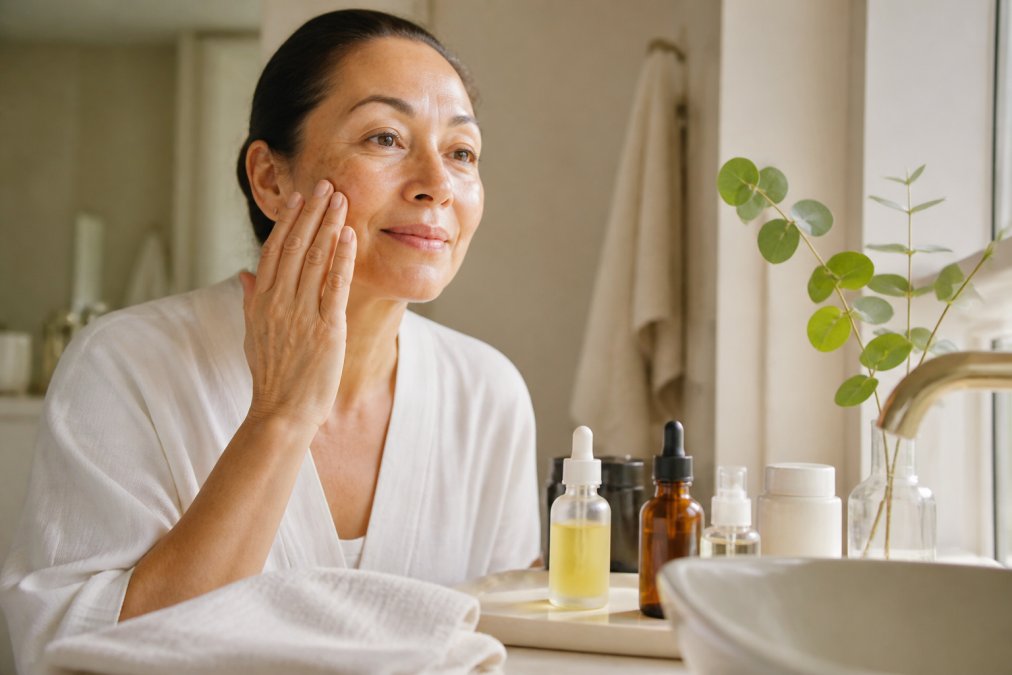
Squalane and the Actives Sensitive Skin Usually Meets
Most guides stop at "put oil last." That advice is fine for a plain moisturizer, but it can work against you when prescription or over-the-counter actives are in the mix. Here is how squalane tends to behave alongside the ingredients reactive skin encounters most.
Retinoids (tretinoin, adapalene, retinol). An occlusive layer over a retinoid can increase how much of the active reaches the skin, and on a barrier that is already thin, that can push a tolerable dose into a stingy one. A common pattern is to apply the retinoid first, let it settle, then follow with squalane or a squalane-rich cream. Some dermatologists suggest a "buffered" approach instead: moisturizer, then retinoid, then a thin layer of squalane on top. Which suits you depends on how your skin responds, so this is a good question for your care team.
AHAs and BHAs (glycolic, lactic, salicylic). Exfoliating acids and squalane do different jobs and generally coexist well, but order matters. Apply the acid to clean, dry skin, give it the directed contact time, then layer squalane afterward to soften the tight, papery feeling that often follows. Do not mix them in the same step. If your skin is actively reactive, many practitioners suggest pausing acids and leaning on squalane and humectants until the barrier settles.
Vitamin C. Vitamin C serums are acidic and can sting compromised skin on their own. Squalane layered after a vitamin C serum can buffer some of that immediate tightness without interfering with the serum's job. If you use a derivative rather than L-ascorbic acid, the sting is usually milder, and squalane on top keeps the finish comfortable.
Niacinamide and hydrating serums. These are the easy pairings. Niacinamide, hyaluronic acid, glycerin, and panthenol all play nicely under squalane. Apply the water-based serum first, then seal with squalane. This is the combination most sensitive-skin routines settle into.
A Note on "Oil Before or After Moisturizer"
You will see both orders recommended, and both can be right depending on the product. A lightweight squalane can go under a heavier cream if you want the cream to do the final sealing; a richer squalane blend usually goes on last. The practical test is texture: if the product after your squalane pills or slides around, flip the order. If it sinks in and the finish feels comfortable, you have it right.
When to Ask Before You Layer
If you are in active treatment, using prescription topicals, or managing a diagnosed skin condition, the order of your products is worth a conversation with your oncology or dermatology care team. They can see your skin, know your treatment, and flag anything that should sit out for now. Our Ingredient Index lists what is in each Lotus formula in plain language so you can bring a clear list to that conversation.
Fragrance-Free Skincare Benefits for Reactive Skin
Fragrance is one of the most common triggers for contact reactions, and it hides under many names on a label, including "parfum," "essential oil blend," and individual botanical extracts. Fragrance-free skincare benefits reactive skin by removing an entire category of potential irritants rather than trying to balance them.
For skin that is already compromised, this is a practical reduction of variables. When your barrier is thin, even a scent you have worn for years can suddenly sting.
Lotus Beauty Co. formulates 100% fragrance-free, and we publish our full ingredient list so you can check every component against what your care team has flagged. Transparency is the point. You should never have to guess what is in a bottle.
How to Choose a Squalane Product and Patch Test It
Choosing well comes down to a short list of checks. Look for plant-derived squalane, a fragrance-free formula, and a full ingredient disclosure. Then patch test before you commit, especially if your skin is reactive.
Where Squalane Comes From, and Why It Matters
Squalane on a label can trace back to three broad sources, and the source shapes both the ethics and, in some cases, the feel.
Shark liver oil. This was the original commercial source and still appears in some products. Many shoppers prefer to avoid it on animal-welfare grounds, and most mainstream brands have moved away from it. If sourcing matters to you, look for an explicit plant-derived claim.
Olive-derived squalane. Olive squalane is produced from olive oil unsaponifiables, a fraction left over after the oil is refined for food and other uses. It is a well-established cosmetic ingredient with a long safety record, and it tends to have a slightly richer skin feel than sugarcane-derived material. Some find it a touch heavier, which can be a plus for very dry skin and a drawback for oily or combination skin.
Sugarcane-derived squalane. This is made by fermenting sugarcane with yeast, and it produces a very light, fast-absorbing oil, often the choice for facial products where a weightless finish matters. The trade-off is that sugarcane production carries its own agricultural and land-use considerations, so "plant-derived" is not automatically the same as "low impact."
A note on transparency. A thoughtful brand tells you which source it uses and why, not just that the squalane is plant-based. We publish sourcing details for our formulas in our Ingredient Index so you can see what you are putting on your skin.
What Else to Check on the Label
- Fragrance-free, not just "unscented." Unscented products can still contain masking fragrance. Fragrance-free means no added scent at all.
- Short, readable ingredient lists. Fewer ingredients means fewer variables to sort through if something does not agree with you.
- No essential oil blends. Botanical oils smell lovely and can still irritate compromised skin. "Natural fragrance" is not the same as fragrance-free.
- A concentration you can find. Squalane listed near the top of an ingredient list tells you it is doing real work rather than appearing as a token amount.
A Patch Test Protocol for Reactive Skin
A patch test is not a formality. For skin that has changed, it is how you find out whether a product belongs in your routine before it touches your whole face.
- Choose a small area: inner forearm or behind the ear
- Apply a thin layer of the product, not a single drop
- Leave it undisturbed for 24 hours
- Check for redness, itching, burning, or swelling
- If clear, repeat on a small patch of jawline for another 24 hours
- Introduce one new product at a time, never several at once
If a patch test produces redness, itching, or burning, stop using the product and mention it to your care team. A reaction is information, not a failure.
Where to Start
If you are unsure which squalane product fits your skin, our Ingredient Index breaks down what is in each formula in plain language. For dry, depleted skin, a squalane-rich option like Restore Night Cream pairs argan oil, jojoba, shea butter, and squalane to support the moisture barrier overnight, while Awaken Day Cream keeps daytime hydration soft and non-greasy. Used together as The Daily Ritual, they cover morning and evening.


Step |
Product Type |
When |
Frequency |
|---|---|---|---|
Cleanse |
Gentle, non-stripping cleanser |
AM and PM |
Daily |
Hydrate |
Water-based serum on damp skin |
AM and PM |
Daily |
Seal |
Squalane or squalane-rich cream |
AM and PM |
Daily |
Protect |
Sunscreen |
AM |
Daily |
Patch test |
New product on inner forearm |
Before first use |
Once per product |
Conclusion
Finding a routine that respects skin which has changed, sometimes painfully, is genuinely hard, and the trial-and-error gets exhausting. Squalane for dry sensitive skin is a reasonable place to start because it does one job well without asking your barrier to absorb much risk.
At Lotus Beauty Co., every formula is dermatologist tested for irritation and sensitization and guided by our oncology and dermatology advisors. Our skincare collection is fragrance-free, talc-free, and paraben-free, with full ingredient transparency so you can decide with your care team rather than around them. Get started with Lotus Beauty Co. and give your skin something gentle to rely on.
Frequently Asked Questions
Is squalane moisturizing or hydrating?
Squalane is primarily an emollient, which means it softens and smooths the skin's surface and helps slow water loss rather than adding water directly. Hydrators like glycerin draw moisture in; emollients like squalane help keep it there. That's why squalane for dry skin works best layered over a hydrating serum or a damp face, then sealed with a cream. If your skin feels tight and flaky, pairing a humectant with squalane gives you both sides of the equation.
What should you not use squalane with?
There's no strict rule against combining squalane with most ingredients, but reactive skin deserves a slower approach with strong actives. If you use prescription retinoids, exfoliating acids, or high-strength vitamin C, introduce squalane on alternate nights or buffer it over your active to reduce sting. Avoid layering several new products at once, since you won't know what caused a reaction. Your oncology or dermatology team can advise on what's appropriate during your specific treatment.
Is squalane suitable for skin prone to eczema or irritation?
Squalane is generally considered well tolerated because it's a saturated hydrocarbon with no fragrance and a low irritation profile, and it's often included in formulas for reactive skin. That said, eczema is a medical condition, and no cosmetic can treat or prevent it. If you have active flares, check with your dermatologist before adding anything new, and patch test on a small area first. Some people with eczema do find emollients comforting between flares.
What are the side effects of using squalane?
Most people experience no side effects. Because squalane is non-comedogenic and similar to lipids your skin already produces, reactions are uncommon. A small number of people may notice mild congestion or irritation, especially if a formula contains added fragrance, essential oils, or other ingredients rather than pure squalane. If you're introducing a new product during treatment, patch test first and stop if you notice redness, stinging, or new breakouts, then check with your care team.