
How to Read Skincare Ingredient Labels (2026 Guide)
Table of Contents
- Why Learning to Read Skincare Ingredient Labels Matters
- Skincare Ingredients Listed in Order: What the Sequence Tells You
- INCI Names, Botanical Names, and Common Names on a Cosmetic Label
- How to Identify Fragrance in Skincare (and Why Parfum Is Easy to Miss)
- Fragrance-Free vs Unscented Skincare: They Are Not the Same
- Skincare Ingredient Label Examples You Can Practice With
- Conclusion: A Calmer Way to Choose What Touches Your Skin
- Frequently Asked Questions
Last Updated: October 4, 2026
Why Learning to Read Skincare Ingredient Labels Matters
Learning how to read skincare ingredient labels is the most useful skill you can build for sensitive or changing skin. It lets you check what is actually in a product before it touches your face, rather than trusting the front of the box.
Here is the part most guides get wrong: the front label is marketing, and the back label is fact. The FDA guidance on cosmetic labeling requires ingredients to be listed in a set order, which means the back of the bottle tells a more honest story than any claim on the front.
If your skin is reactive, dry, or going through treatment, that difference matters. A product can say "gentle" and still contain a fragrance mix that sets your skin off.
Skincare Ingredients Listed in Order: What the Sequence Tells You
Skincare ingredients are listed in order of concentration, from highest to lowest. That is the core rule, and it does most of the work for you.
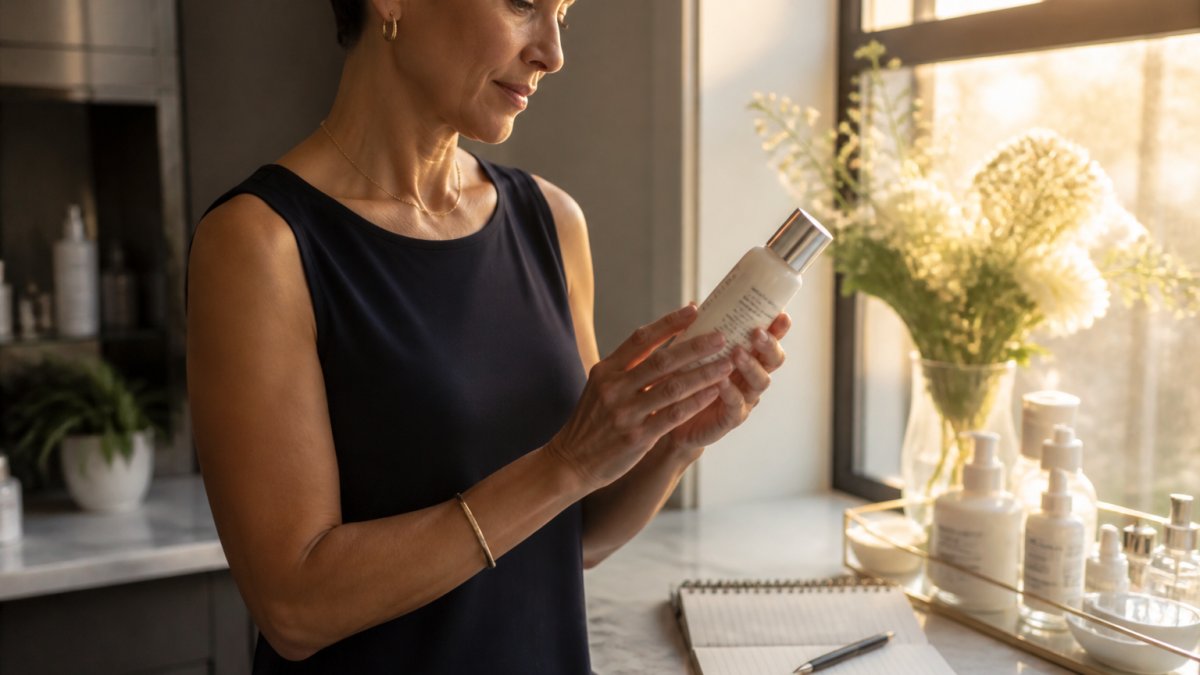
Water, often listed as water or aqua, is almost always first in a cream or lotion. That is normal. What matters is what comes next.
- First third: the base, the main emollients, and the workhorse ingredients.
- Middle: supporting ingredients like humectants and antioxidants.
- Last third: preservatives, fragrance, and trace ingredients.
A common mistake is judging a product by an ingredient near the bottom.
The 1% Rule and Where Trace Ingredients Hide
The 1% rule is a widely used rule of thumb: once an ingredient drops below 1% of the formula, companies may list the remaining ingredients in any order. This is how the labeling system works, not a loophole. Ingredients below that line can appear in any sequence, so their position tells you less. Preservatives and fragrance often sit there, and a "star" ingredient listed last may be mostly for the label.
What Ingredient Order Cannot Tell You
Ingredient order tells you relative position, not exact percentage. You will almost never see "niacinamide 5%" on a back label.
That means a few things to hold in mind:
- You cannot calculate percentages from order. Knowing that an ingredient is third does not tell you whether it is 12% or 3%.
- A lower-listed ingredient can still be effective. Some ingredients, like certain peptides or retinoids, work at very low concentrations.
- A higher-listed ingredient is not automatically better. Water is usually first, and that is fine. Position reflects amount, not importance.
A common pattern is that preservatives like phenoxyethanol, sodium benzoate, or potassium sorbate sit at or below the 1% line, along with fragrance and most botanical extracts. When you see those names, everything after them is likely in the trace zone.
Concentration, Formulation, and Why the Same Ingredient Behaves Differently
Two products can list the same hero ingredient and deliver very different results. Concentration is only one variable. Formulation, stability, and delivery matter just as much.
- Concentration: how much is present. Higher is not always better, and some ingredients become irritating above a certain level.
- Formulation: what the ingredient is paired with. A soothing ingredient in a stripping base may not feel soothing.
- Stability: some ingredients, like vitamin C in certain forms, degrade with light and air. A label cannot tell you whether the formula held up.
This is why front-label claims like "with hyaluronic acid" or "infused with vitamin C" deserve a closer look. The claim may be accurate and still tell you very little about how much is present or whether it will do anything for your skin.
How to Weigh Evidence Behind an Ingredient
Not every ingredient has the same level of research behind it. When deciding what to trust, ask a few plain questions:
- Is there human research, or only lab-dish and animal studies? Lab findings do not always translate to skin.
- How many people, and for how long? Small, short studies are weaker than larger, longer ones.
- Who paid for the research? Industry-funded studies are not automatically wrong, but independent replication matters.
You do not need to become a researcher. Just notice when a claim is doing more work than the evidence behind it.
INCI Names, Botanical Names, and Common Names on a Cosmetic Label
A cosmetic label uses INCI names, which stands for International Nomenclature of Cosmetic Ingredients.
That is why you see "aqua" instead of water, or "tocopherol" instead of vitamin E. It looks clinical, but it exists to reduce confusion, not create it.
Botanical names add another layer. Plant ingredients are often listed by their Latin or scientific name, sometimes with the common name in parentheses.
- Aqua = water
- Tocopherol = vitamin E
- Squalane = a skin-friendly emollient
Once you learn a handful of these translations, labels stop looking like a foreign language. Our INCI database for cosmetic ingredients is a useful reference when you hit a name you do not recognize.
How to Identify Fragrance in Skincare (and Why Parfum Is Easy to Miss)
Fragrance hides behind several names, and "parfum" is the one people miss most. On a label, parfum and fragrance mean the same thing: a blend of scent ingredients that does not have to be broken down individually.
A single word can stand in for dozens of compounds, and some of them are common sensitizers.
Watch for these terms:
- Parfum
- Fragrance
- Aroma
If your skin reacts easily, fragrance is one of the first things to screen out. Our American Academy of Dermatology on fragrance sensitivity notes that fragrance is among the most common causes of allergic contact reactions in skincare.
Fragrance-Free vs Unscented Skincare: They Are Not the Same
Fragrance-free and unscented are not interchangeable, even though they sound identical. This is one of the most misunderstood pairs in skincare.
So an unscented product can still contain fragrance. For reactive or treatment-affected skin, that distinction matters.
- Fragrance-free: no added fragrance. The safer default for sensitive skin.
- Unscented: no smell, but fragrance may still be present.
- "Lightly scented": fragrance is present by definition.
If you are unsure, scan the ingredient list for parfum, fragrance, or aroma. If any of them appear, the product is not fragrance-free, no matter what the front says.
At Lotus Beauty Co., our full line is 100% fragrance-free, and every formula is listed in plain terms on our Lotus Beauty Co. Ingredient Index(https://lotusbeautyco.com/pages/ingredient-index) so you can check before you buy.
Skincare Ingredient Label Examples You Can Practice With
Reading labels gets easier with real examples. Below are three common product types, with the kind of ingredient list you might see and how to read it line by line. These are illustrative patterns, not specific brand formulas, so you can apply the same thinking to whatever is in your bathroom.
Example 1: A Daily Moisturizer
A typical fragrance-free moisturizer might list ingredients in roughly this order:
- Water (aqua)
- Glycerin
- Caprylic/capric triglyceride
- Squalane
- Butyrospermum parkii (shea butter)
- Cetearyl alcohol
- Tocopherol (vitamin E)
- Phenoxyethanol
- Sodium hyaluronate
- Allantoin
How to read it:
- Water and glycerin lead. Water is the base. Glycerin is a humectant that draws water into the upper layers of skin. Both near the top is normal and good.
- Emollients come next. Caprylic/capric triglyceride, squalane, and shea butter soften and smooth. Their position suggests they make up a meaningful share of the formula.
- Cetearyl alcohol is not drying. Despite the word "alcohol," this is a fatty alcohol used as an emulsifier and thickener, not the same as drying alcohols like denatured alcohol.
Example 2: A Cleanser
A gentle cleanser might list:
- Water (aqua)
- Glycerin
- Cocamidopropyl betaine
- Sodium cocoyl isethionate
- Coco-glucoside
- Panthenol
- Sodium chloride
- Citric acid
- Phenoxyethanol
- Disodium EDTA
How to read it:
- Surfactants come after water and glycerin. Cocamidopropyl betaine, sodium cocoyl isethionate, and coco-glucoside are the cleansing agents. These are generally considered milder than sulfates like sodium lauryl sulfate, though individual tolerance varies.
- Panthenol is a soothing humectant. It sits in the middle, which suggests a modest but real amount.
- Sodium chloride and citric acid adjust texture and pH. These are functional ingredients, not actives.
Example 3: A Sunscreen
Sunscreens are structured differently. In the United States, active sunscreen filters are listed separately from other ingredients, so you will see two sections on the label.
Active ingredients might include:
- Zinc oxide
- Titanium dioxide
Inactive ingredients might include:
- Water (aqua)
- Caprylic/capric triglyceride
- Glycerin
- Squalane
- Tocopherol
- Phenoxyethanol
How to read it:
- The active section tells you what is protecting your skin. Zinc oxide and titanium dioxide are mineral filters that sit on top of skin and deflect UV rays. Chemical filters work differently, absorbing UV and converting it to heat.
- The inactive section tells you how it feels. Emollients and humectants shape texture and finish. They do not provide sun protection.
- The FDA sunscreen labeling rules explain how actives and inactives are separated. That structure is why sunscreen labels look different from moisturizer labels.
| Product Type | First Ingredients to Check | Common Irritants to Screen | What to Look For |
|---|---|---|---|
| Moisturizer | Water, emollients | Parfum, fragrance | Squalane, shea butter |
| Night cream | Butters, oils | Aroma, essential oils | Soothing botanicals |
| Cleanser | Surfactants | Sulfates, fragrance | Humectants, gentle surfactants |
| Sunscreen | Filters, water | Fragrance, alcohol | Broad-spectrum filters |
A Note on Allergy and Sensitivity Screening
Ingredient lists are useful for spotting known allergens, but they cannot predict every reaction. If you have a confirmed allergy, check the list against your known triggers and patch-test new products on a small area before using them widely. If you are unsure, your dermatology or oncology care team can help you decide what to avoid.
How to Verify What You Are Reading
When a name or claim is unfamiliar, a few reliable habits help:

- Cross-check the INCI name. Databases like the INCI database for cosmetic ingredients can translate a name into plain language.
- Look up the ingredient on a government or academic source. The FDA guidance on cosmetic labeling explains labeling rules, and the American Academy of Dermatology on fragrance sensitivity covers common sensitizers.
- Check our own Lotus Beauty Co. Ingredient Index(https://lotusbeautyco.com/pages/ingredient-index). Every formula is listed in plain terms so you can see exactly what is inside before you buy.
Conclusion: A Calmer Way to Choose What Touches Your Skin
Reading skincare ingredient labels does not require a science degree. It requires knowing the order, recognizing a few key names, and checking the back of the bottle before the front.
If you would rather not do the detective work alone, that is exactly why we built Lotus Beauty Co. You can explore our skincare collection(https://lotusbeautyco.com/collections/skincare) and use Find My Shade(https://lotusbeautyco.com/collections/cosmetics) for cosmetics that match you.
Get started with Lotus Beauty Co. and choose your daily products with confidence.
Frequently Asked Questions
Are skincare ingredients listed in order of concentration?
Yes, with one important exception. Ingredients are listed from highest to lowest concentration until you reach the point where they make up 1% or less of the formula. After that point, brands can list the remaining ingredients in any order. That is why two products can both list a botanical extract, yet one may contain far more of it than the other. Reading the first five or six ingredients usually tells you more about the formula than the last twenty.
What is the 1% rule in skincare, and how does it affect what I am reading?
The 1% rule refers to the labeling convention where ingredients below 1% concentration can appear in any order. Preservatives, fragrance components, and many active botanicals often sit below that threshold. This means a label cannot tell you the exact percentage of an ingredient, only whether it is likely above or below that line. If a brand makes a strong claim about an ingredient near the bottom of the list, it is reasonable to ask them directly about the concentration.
How can you tell if a skincare product is fragrance-free?
Look for the words fragrance-free on the front of the package, then check the ingredient list for fragrance, parfum, aroma, or essential oils such as lavender, citrus, or peppermint. A product labeled unscented may still contain a masking fragrance to cover the natural scent of raw ingredients, so the ingredient list is the more reliable source. If a company publishes a full ingredient index, that transparency makes verification much easier.
What does parfum mean on a skincare label?
Parfum is the INCI term for fragrance. It can represent a single aromatic compound or a blend of dozens of ingredients, and companies are not required to break down every component on the label. For anyone with sensitive or reactive skin, parfum is one of the most common triggers to watch for. If you are unsure whether a specific product is appropriate for your skin, your dermatology or oncology care team can help you decide.