
Talc-Free Cosmetics for Sensitive Skin: 2026 Guide
Table of Contents
- Talc-Free Cosmetics for Sensitive Skin: What Actually Matters
- Quick Comparison: Our Talc-Free Favorites at a Glance
- Talc-Free Makeup Brands: What Sets Thoughtful Formulations Apart
- Talc-Free Powder Foundation and Pressed Powders for Sensitive Skin
- Talc Alternatives in Cosmetics: What Formulators Use Instead
- How to Read Cosmetic Ingredient Labels (Without Feeling Overwhelmed)
- Choosing Talc-Free Cosmetics for Sensitive Skin: A Practical Decision Guide
- Conclusion: A Gentle Return to Your Beauty Ritual
- Frequently Asked Questions
Last Updated: October 7, 2026
Talc-Free Cosmetics for Sensitive Skin: What Actually Matters
If your skin has become reactive, dry, or unpredictable during treatment, the label on your makeup matters more than the shade inside it. Talc-free cosmetics for sensitive skin are made without talc, a soft mineral many women now choose to avoid.
Skin going through chemotherapy, radiation, or hormone therapy often has a compromised barrier. Products that felt fine two years ago can suddenly sting, and fragrance, drying alcohols, and some powders become intolerable.
Your oncology or dermatology care team can help you decide what is right for your situation.
Quick Comparison: Our Talc-Free Favorites at a Glance
Here is a short look at the Lotus Beauty Co. products we reach for most when skin is sensitive.
| Product | Price | Best For | Why It Stands Out |
|---|---|---|---|
| Hydrating Liquid Foundation | $48.00 | All-over, breathable coverage | Buildable, lightweight, 15 shades |
| Beauty Stick Foundation | $46.00 | Targeted or full-face coverage | Cream stick, glides without dragging |
| Cream Concealer Mirrored Palettes | $52.00 | Redness and dark circles | Softens uneven tone, 4 options |
| Multi-Use Color Stick | $38.00 | Cheeks, lips, and eyes | One swipe, three ways |
| Nourishing Lipstick | $28.00 | Dry, delicate lips | Castor oil and shea butter, 17 shades |
| Mechanical Brow Stick | $28.00 | Thinning or delicate brows | Soft, hair-like strokes |
| Lip Glaze | $26.00 | Sheer shine and comfort | Non-sticky, 10 shades |
Every item above is fragrance-free, talc-free, and paraben-free, and each avoids sulfates and drying alcohols. Browse the full cosmetics range and use virtual shade matching to narrow your options before you buy.

Talc-Free Makeup Brands: What Sets Thoughtful Formulations Apart
The brands worth your attention share one habit: they tell you what is inside and why.
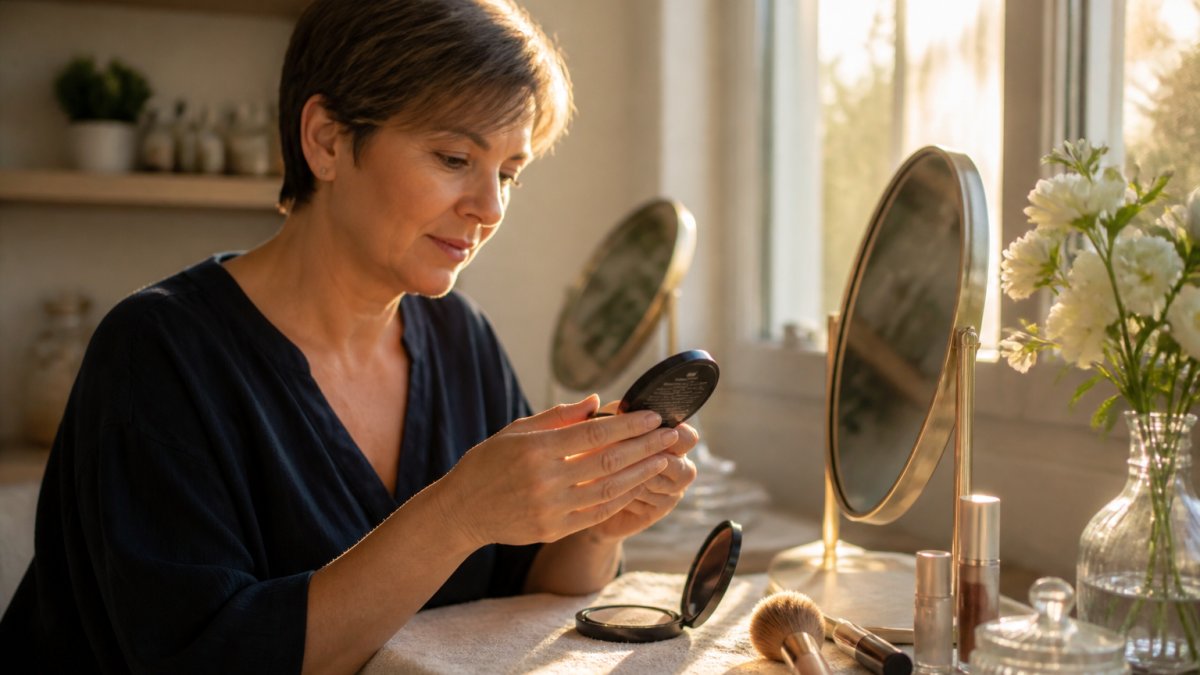
At Lotus Beauty Co., our formulas are developed with medical insight in mind and reviewed with oncology and dermatology advisors.
What most guides miss is that "talc-free" and "gentle" are not the same claim. Our Ingredient Index exists for exactly that reason.
The FDA's guidance on cosmetics and ingredient labeling is a useful reference for understanding what companies are required to disclose, and where transparency still depends on the brand's own choices.
Talc-Free Powder Foundation and Pressed Powders for Sensitive Skin
Powder is often the first category women reconsider, because talc has traditionally been the backbone of pressed and loose powders, giving them slip, oil absorption, and soft-focus blur.
The trade-off is real. Talc is prized for slip and oil absorption, so a talc-free powder may need a lighter hand and a better-prepared base underneath. On sensitive or dry skin, powder applied over moisturized skin sits far better than powder applied to bare, tight skin.
What to look for in a talc-free powder
- A short, readable ingredient list. If you cannot find the full list on the product page or the carton, that is your first signal.
- No added fragrance. "Fragrance" and "parfum" are among the most common triggers for reactive skin, and they show up in powders more often than people expect.
- Emollients near the top. Look for shea butter, squalane, or esters that keep the powder from pulling moisture out of the skin.
- A finish that matches your skin today. Matte formulas can emphasize flaking on very dry patches. A satin or soft-focus finish tends to sit more comfortably.
How to verify a powder is actually talc-free
Talc is usually listed plainly as "talc" on the ingredient list, so a quick search of the label will confirm it. Two things trip people up. Some brands list it alongside other minerals, so read the whole list rather than scanning the front of the compact.
If a brand does not publish a full ingredient list, ask their customer service for it directly. A brand confident in its formulation will usually share it.
Powder, cream, or liquid: a practical comparison
| Format | Best for | Finish | Watch for |
|---|---|---|---|
| Pressed or loose powder | Setting makeup, reducing shine, combination skin | Soft-focus to matte | Can emphasize flaking on very dry patches |
| Cream | Dry or reactive skin, targeted coverage | Radiant, skin-like | Needs a light touch to avoid settling into texture |
| Liquid | Customizable coverage, most skin types | Natural to full | Can separate over very dry or very oily areas |
For many women in treatment, a cream or liquid base with a light dusting of powder only where shine appears is the most comfortable combination. Our skincare collection is designed to sit underneath makeup without adding irritation.
If your skin is currently very reactive, patch test any new powder on your jawline or inner arm before applying it to your full face, and talk with your oncology or dermatology care team about what is right for your situation.
Talc Alternatives in Cosmetics: What Formulators Use Instead
Talc alternatives in cosmetics take over talc's jobs: absorbing oil, adding slip, and creating a soft-focus finish. Here is a plain-language translation of the names you will see, along with what each does and where it can go wrong on sensitive skin.
- Mica adds shimmer and slip, and it appears in many mineral makeup formulas. It is generally well tolerated, but the fine particles can feel drying on very reactive skin.
- Silica absorbs oil and blurs texture, and it is common in setting powders. It is effective, but it can be drying if it sits high on the ingredient list.
- Kaolin and other clays absorb oil gently and suit combination skin. They can feel tight on dry skin, so look for them lower on the list.
- Cornstarch and rice starch absorb moisture and feel soft, though they can cake on very dry skin and may feed the yeast that causes some types of folliculitis.
- Boron nitride gives a smooth, powdery feel without the weight, and it is often used in higher-end pressed powders.
- Zinc stearate improves adhesion and slip, and it appears in many pressed powders. It is generally well tolerated, though a small number of people find stearates irritating.
How to check a formula for hidden irritants
A common mistake is assuming "mineral" automatically means gentle. Mineral makeup can still contain mica, bismuth oxychloride, or fragrance that irritates reactive skin. When you read a label, scan for these alongside talc:
- Fragrance or parfum, including "natural" fragrance, which can still trigger reactions.
- Bismuth oxychloride, a mineral that gives a pearly finish but is a known irritant for some people.
- Drying alcohols, such as alcohol denat or SD alcohol, which can strip an already compromised barrier.
- Essential oils, such as lavender, citrus, or peppermint, which are natural but not automatically gentle.
The ingredient list, not the category label, tells you what you are getting. Our Ingredient Index explains the role of each ingredient we use and why we chose it.
Why we formulate the way we do
At Lotus Beauty Co., our formulas are developed with medical insight in mind and reviewed with oncology and dermatology advisors. We remove common irritants: added fragrance, parabens, sulfates, and drying alcohols. Then we build texture that works on skin that has changed.
The FDA's guidance on cosmetics and ingredient labeling is a useful reference for understanding what companies are required to disclose, and where transparency still depends on the brand's own choices.
How to Read Cosmetic Ingredient Labels (Without Feeling Overwhelmed)
Reading a cosmetic ingredient label gets easier once you know the order. Ingredients are listed from highest to lowest concentration, so the first five names tell you most of what the product is.
A practical way to scan a label in under a minute:
- Check the first five ingredients. If fragrance or alcohol appears early, set it aside.
- Search the list for "fragrance," "parfum," "alcohol denat," and "SD alcohol." These are common irritants.
- Look for "talc" by name. It is usually listed plainly.
- Note whether emollients like shea butter, castor oil, or glycerin appear. These support comfort.
- Confirm the product says "fragrance-free," not "unscented." Unscented products can still contain masking fragrance.
The difference between "unscented" and "fragrance-free" trips up a lot of people. Unscented means no noticeable smell, which a company can achieve by adding fragrance to mask other scents.
The American Academy of Dermatology's guidance on sensitive skin offers helpful background on how to identify products that are less likely to trigger a reaction.
Choosing Talc-Free Cosmetics for Sensitive Skin: A Practical Decision Guide
Choosing talc-free cosmetics for sensitive skin comes down to three questions: what your skin needs right now, what finish you want, and how much coverage feels comfortable.
Use this framework to decide:
| If Your Skin Is... | Start With | Finish to Look For | Avoid |
|---|---|---|---|
| Very dry or flaking | Cream or liquid base | Radiant, dewy | Heavy matte powders |
| Reactive or stinging | Fragrance-free cream | Sheer, buildable | Anything with added fragrance |
| Combination | Liquid base plus light powder | Natural, soft-focus | Full-coverage matte |
| Post-treatment, uneven tone | Cream concealer plus liquid | Skin-like | Cakey layering |
Start with one product, not a full routine. Switching everything at once makes it hard to tell what is working. Add one item, use it for a week, and see how your skin responds.

For coverage, match the formula to the moment. The Hydrating Liquid Foundation is our most flexible option, with buildable coverage in 15 shades. When you want to spot-correct rather than cover everything, the Cream Concealer Mirrored Palettes soften redness and dark circles without a heavy feel.
Conclusion: A Gentle Return to Your Beauty Ritual
Your reflection should feel like yours, and a makeup routine built around comfort can help with that. The shift to talc-free, fragrance-free formulas is not about restriction.
Lotus Beauty Co. was built for exactly this. Our formulas are 100% fragrance-free, talc-free, and paraben-free, with full ingredient transparency so you always know what you are putting on your skin.
If you are ready to rebuild your routine gently, start with one product and see how it feels.
Frequently Asked Questions
What makeup brands do not contain talc?
Brands that publish full ingredient lists and confirm talc-free status on their packaging are the easiest to trust. Lotus Beauty Co. formulates all products without talc, parabens, sulfates, added fragrance, or drying alcohols. When checking any brand, look for the word 'talc' on the ingredient panel, and reach out to customer service if it is not listed. Transparency matters more than a marketing claim.
Is talc safe for sensitive skin?
Talc is a mineral used historically in powders to absorb moisture and improve texture. Some people with sensitive or reactive skin prefer to avoid it, especially if they have had irritation from pressed powders. If you are unsure whether talc is right for your skin, talk with your dermatology or oncology care team. Choosing talc-free powder foundation is one way to simplify your routine while reducing potential irritants.
What can I use instead of talc in makeup?
Common talc alternatives in cosmetics include mica, silica, kaolin clay, cornstarch, and rice starch. Each has a different feel: mica adds slip and light reflection, silica blurs, and clays absorb oil. For sensitive skin, look for finely milled powders without added fragrance. Lotus Beauty Co. uses gentle mineral ingredients and publishes full ingredient lists so you can check every component before buying.
How can I check whether a cosmetic product contains talc?
Turn the product over and read the ingredient list. Talc appears as 'talc' or 'talcum powder.' If the label is unclear or the brand does not publish a full list online, contact the company directly. Lotus Beauty Co. lists every ingredient on each product page and in our Ingredient Index, so you can verify talc-free status before you order.
How should I patch test new makeup if my skin is sensitive?
Apply a small amount to a discreet area, such as behind your ear or on your inner forearm, and wait 24 to 48 hours. If you are in active treatment, ask your care team whether patch testing is appropriate for you. Start with one new product at a time so you can identify what works. Lotus Beauty Co. products are dermatologist tested for irritation and sensitization, but individual responses vary.