
Skincare Gift Ideas for Cancer Patients: 2026 Guide
Table of Contents
- What Makes a Skincare Gift Truly Comforting
- Oncology-Safe Skincare Products: What to Look For
- Gift Ideas for Dry and Sensitive Skin
- Skincare Gift Ideas for Cancer Patients Who Wear Makeup
- A Sensitive Skin Care Routine for Cancer Patients
- Sun Protection for Immunocompromised Skin
- How to Support Someone During Cancer Treatment
- Frequently Asked Questions
Last Updated: September 13, 2026
What Makes a Skincare Gift Truly Comforting
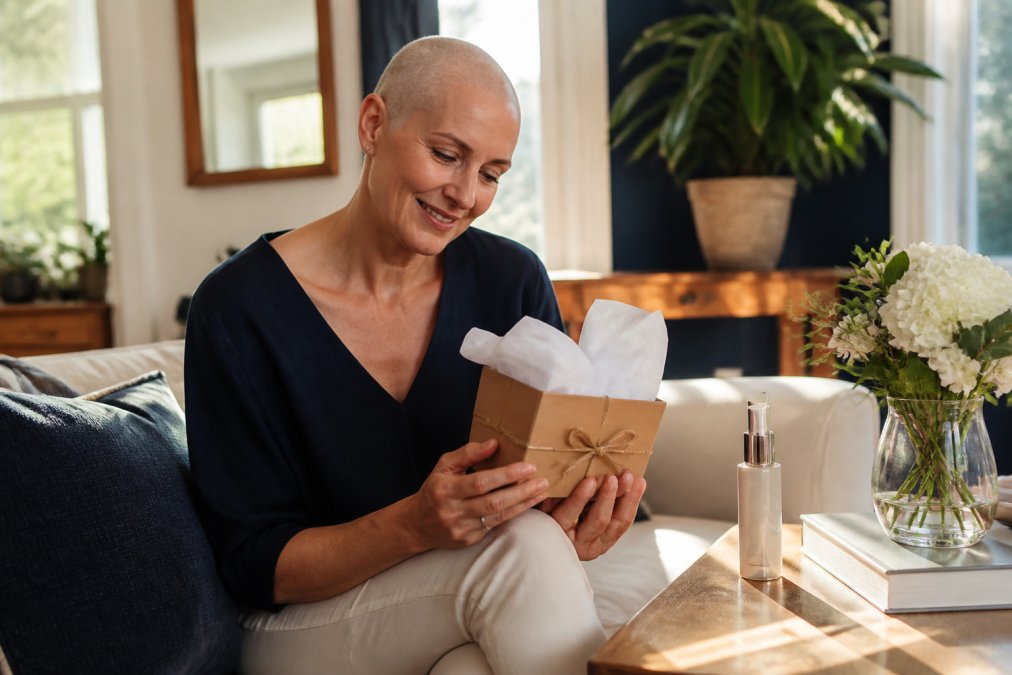
The most comforting skincare gift ideas for cancer patients ask nothing of the person receiving them. No scent to tolerate, no routine to learn, no note about "getting your glow back." A thoughtful gift is about recognition: helping someone feel like herself on a day when her reflection may not match how she feels inside.
That distinction matters, because skin during treatment genuinely changes. Chemotherapy can leave skin dry, flushed, or reactive, and radiation can make the treated area tender (cancer.org). A gift that ignores those realities can end up untouched on a shelf.
Below, we walk through what to look for, what to avoid, and how to build a gift that feels safe and personal. The guiding principle: comfort first, fragrance never, and always let her decide.
Oncology-Safe Skincare Products: What to Look For
Oncology-safe skincare products are built around a short, transparent ingredient list, no added fragrance, and no harsh exfoliants or drying alcohols. They prioritize hydration and barrier support over active "results," because comfort matters more than correction right now.
When choosing a gift, look for products described as fragrance-free rather than "unscented," since unscented formulas can still contain masking fragrance. Hypoallergenic and non-comedogenic labels are helpful signals, though neither guarantees a reaction-free experience.
A few practical markers worth checking:
- Fragrance-free and paraben-free formulas
- No drying alcohols, sulfates, or physical scrubs
- Simple, recognizable ingredients like shea butter, jojoba, and squalane
- Full ingredient lists published openly, not summarized in marketing language
The American Cancer Society guidance on skin changes during treatment is a useful starting point for understanding why skin becomes more reactive, and it is worth sharing with a caregiver who wants to shop responsibly.
Ingredients to Avoid During Cancer Treatment
Certain ingredients are commonly flagged for sensitive skin: added fragrance, essential oils, drying alcohols, strong exfoliating acids, and retinoids. These can sting, strip the moisture barrier, or trigger irritation when skin is already fragile.
That does not mean every ingredient on a "watch" list is dangerous for everyone. It means the margin for error is smaller, so simpler is kinder. If you are unsure whether a product suits someone in active treatment, ask her care team first.
- Added fragrance and essential oils. Fragrance is a common cause of contact reactions in sensitive skin. Essential oils like citrus, peppermint, lavender, and eucalyptus are natural fragrance sources and can irritate reactive skin even when a label calls them "botanical."
- Drying alcohols. Denatured, SD, and isopropyl alcohol evaporate quickly and can pull moisture from a depleted barrier. Fatty alcohols like cetyl and stearyl are different and often used as emollients, so not every "alcohol" is a concern.
- Exfoliating acids. Glycolic, lactic, and salicylic acids, plus enzyme peels, loosen the top layer of skin. On skin that is thin, tender, or recovering from radiation, that can mean stinging and prolonged redness.
- Retinoids. Retinol, retinal, and prescription retinoids speed cell turnover and can cause peeling and photosensitivity, a poor match for skin already stressed by treatment.
- Strong antibacterial washes. Harsh antibacterial soaps can disrupt the skin's natural balance. A mild, non-foaming cleanser is usually gentler.
How to Read an Ingredient Label
Reading a label well comes down to three habits: scan for fragrance first, check the first five ingredients for anything drying, and look for a published full list. Ingredients are listed by concentration, so what appears early matters most.
Look for:
- Ceramides, which help reinforce the skin barrier
- Hyaluronic acid and glycerin, which draw in and hold water
- Squalane, shea butter, jojoba, and argan oil, which soften and cushion
- Panthenol (vitamin B5) and allantoin, often used in soothing formulas
- Colloidal oatmeal, a long-recognized skin protectant
Approach with caution:
- "Fragrance" or "parfum" anywhere on the list
- Essential oil blends, even when labeled natural
- Denatured or SD alcohol near the top of the list
- Glycolic, lactic, and salicylic acids
- Retinol and other retinoids
Two label terms trip people up most often. "Unscented" can mean a masking fragrance was added to cover the smell of raw ingredients, while "fragrance-free" means no fragrance was added at all. "Hypoallergenic" is a marketing term rather than a regulated standard, so it is a starting point, not a guarantee. When in doubt, patch-test on the inner forearm and wait a day before wider use.
Our Lotus Beauty Co. Ingredient Index exists for exactly this reason. We publish what is in each formula and why, so a gift-giver can make a confident choice instead of guessing.
Gift Ideas for Dry and Sensitive Skin
For dry, sensitive skin, the most reliable gifts are rich, fragrance-free moisturizers and gentle cleansers that support the moisture barrier. Two products used consistently tend to help more than a shelf full of options.
Soothing Lotions and Creams
A good day cream and a richer night cream cover most of what dry skin needs. Our Lotus Beauty Co. Awaken Day Cream uses aloe, argan oil, jojoba, and shea butter for soft, non-greasy hydration, while Restore Night Cream adds squalane for overnight comfort. Both are fragrance-free and formulated with treatment-affected skin in mind.

If you want one gift that covers morning and evening, the Return to Self Gift Set pairs both creams in a soft fabric cosmetic bag, easy to give without overthinking the details.

Gentle Cleansing and Barrier Support
Cleansing should never feel like a chore or a sting. A mild, non-foaming cleanser applied with lukewarm water and patted, not rubbed, dry is gentlest. Follow with moisturizer while skin is still slightly damp.
Skincare Gift Ideas for Cancer Patients Who Wear Makeup
For someone who still wants to wear makeup, the kindest gifts are breathable, fragrance-free formulas that feel light and layer gradually. Makeup during treatment is not vanity; for many women it is a small daily ritual that helps them feel like themselves.
Our [Hydrating Liquid Foundation(/products/hydrating-liquid-foundation-15-shades) | lotusbeautyco.com] offers buildable, natural-looking coverage in inclusive shades, and the Beauty Stick Foundation glides on without dragging for targeted coverage. A Cream Concealer Palette can softly correct redness or dark circles without feeling heavy.
If you are unsure which shade to choose, our virtual shade matching tool takes the guesswork out of gifting. For lips and brows, a Nourishing Lipstick or Brow Stick adds a familiar finishing touch without tugging.
Gift Category |
What to Look For |
Why It Helps |
|---|---|---|
Moisturizer |
Fragrance-free, rich, barrier-supporting |
Comforts dry, depleted skin |
Cleanser |
Mild, non-foaming, no exfoliants |
Avoids stripping fragile skin |
Foundation |
Breathable, buildable, inclusive shades |
Even tone without heaviness |
Lip color |
Creamy, conditioning, no added fragrance |
Comfort for dry, delicate lips |
Sunscreen |
Broad-spectrum, mineral, fragrance-free |
Protection for sensitive skin |
A Sensitive Skin Care Routine for Cancer Patients
A sensitive skin care routine for cancer patients should be short: cleanse gently, moisturize while damp, and protect with sunscreen during the day. Three consistent steps usually serve skin better than a long list of products.
Here is a simple framework you can share with a gift:
- Morning: Rinse with lukewarm water or a mild cleanser, apply day cream, then sunscreen.
- Midday: Reapply moisturizer to hands and any tight, dry areas.
- Evening: Cleanse gently, pat dry, and apply a richer night cream.
- As needed: Use a lip balm or nourishing lip product for dryness.
Encourage her to patch-test anything new on a small area first, and to pause any product that stings or burns. If a reaction does not settle, her oncology or dermatology team is the right resource.
Hand and Foot Care for Neuropathy
Hand and foot care deserves its own attention, because some treatments cause tingling, numbness, or dry, cracking skin on the hands and feet, sometimes called hand and foot syndrome. A rich, fragrance-free cream massaged gently into hands and feet can ease tightness and keep skin from splitting.
Sun Protection for Immunocompromised Skin
Sun protection matters more during and after treatment, because some therapies make skin more sensitive to ultraviolet light and slower to recover from sun exposure. It is one of the most overlooked gift categories, and one of the most practical, because a sunscreen someone actually enjoys using is one she will keep reaching for. The two main types work differently, and that difference matters for reactive skin:
- Mineral (physical) sunscreens use zinc oxide or titanium dioxide. They sit on top of the skin and deflect UV rays. They tend to be gentler on sensitive skin and less likely to sting, though some leave a visible cast, especially on deeper skin tones. Tinted mineral formulas can help offset that.
- Chemical sunscreens use ingredients like avobenzone, octisalate, and oxybenzone to absorb UV rays and convert them to heat. They feel lighter and leave less residue, but they can sting on compromised skin and are more likely to trigger irritation for some people.
For skin that is tender, radiation-treated, or simply reactive, many dermatology teams suggest starting with a fragrance-free mineral formula and patch-testing first. If it feels too heavy or leaves a cast, a tinted version or a mineral-chemical hybrid may fit better. There is no single right answer, which is why a gift card to a retailer she trusts can be just as thoughtful as a specific bottle.
- Broad-spectrum matters. Look for "broad-spectrum" on the label, which means the formula protects against both UVA and UVB. The U.S. Food and Drug Administration sunscreen guidance explains how that labeling works.
- SPF 30 or higher is the common recommendation for daily use. Higher SPF numbers offer diminishing returns and can encourage people to reapply less often than they should.
- Reapply every two hours outdoors, and after swimming, sweating, or toweling off. For someone with low energy, a sunscreen stick or a tinted mineral SPF that doubles as light coverage can make reapplication easier.
- Sun protection is more than sunscreen. A wide-brimmed hat, a soft UPF wrap or scarf, and sunglasses round out a protective set that is genuinely useful and easy to use on a low-energy day.
- Check with her care team about any specific sun-sensitivity concerns tied to her treatment, since some therapies carry stronger photosensitivity warnings than others.
A good sunscreen, a wide-brimmed hat, and a soft UPF wrap make a practical, protective gift that many people in treatment genuinely use. If you would like to build one, our skincare collection includes fragrance-free daily essentials that pair well with a sun-protective set.

How to Support Someone During Cancer Treatment
Supporting someone during treatment starts with asking what she actually wants, then following her lead. Some women want practical help; others want company, a meal, or simply to be treated like themselves rather than a diagnosis.
A gift works best when it comes with permission to ignore it. Say something like, "No pressure to use this, I just wanted you to have something soft and scent-free on hand." That framing removes obligation and lets her choose when to engage with it.
Budget-Friendly DIY Care Packages
A thoughtful care package does not require a large budget. The most appreciated items are often the simplest and most practical, and assembling them yourself adds a personal touch.
- A fragrance-free moisturizer and a gentle cleanser
- Soft cotton gloves and socks for hand and foot care
- A wide-brimmed hat and fragrance-free sunscreen
- A nourishing lip balm or lip product
- A soft, washable head wrap or beanie
- A small notebook for questions and appointments
If you would like to include a ready-made option alongside your DIY picks, the Return to Self Gift Set pairs a day cream and night cream in a soft cosmetic bag, and our skincare collection has individual pieces if you would rather build your own.
Skin changes during treatment can feel like one more thing out of a woman's control, and a good gift cannot take that away. What it can do is offer a small, safe ritual that feels like her own. At Lotus Beauty Co., we build fragrance-free, dermatologist-tested skincare and cosmetics for women navigating cancer, guided by oncology and dermatology advisors, with full ingredient transparency and shades for every skin tone. Start with the Return to Self Gift Set or explore our skincare collection, and give something that offers comfort, dignity, and a gentle return to self.
Frequently Asked Questions
What do cancer patients want as gifts?
Many appreciate gifts that offer everyday comfort without drawing attention to their diagnosis. Fragrance-free moisturizers, gentle lip balms, soft blankets, and unscented hand creams tend to be well received. Skincare gift ideas for cancer patients work best when they prioritize sensitive skin needs and simple, calming rituals rather than elaborate products. A small, thoughtfully chosen set often means more than a large, generic basket.
How do I choose oncology-safe skincare products?
Start by looking for fragrance-free formulas, since fragrance is a common irritant for sensitive skin. Check that the brand offers full ingredient transparency and avoids drying alcohols. If you are unsure, ask the recipient's oncology or dermatology care team whether a specific product fits their situation. Oncology-safe skincare products should support comfort, not promise to treat any medical condition.
What ingredients should be avoided in skincare for sensitive, treatment-affected skin?
Added fragrance, drying alcohols, and harsh exfoliating acids are common triggers for reactive skin. Some people also react to essential oils, even natural ones. Look for short, clear ingredient lists with soothing botanicals, plant oils, and moisture-supporting ingredients like shea butter, jojoba, and squalane. When in doubt, patch test on a small area first and check with a care team member.
Why is fragrance-free skincare recommended during cancer treatment?
Treatment can make skin more reactive, and fragrance is one of the most frequent causes of irritation and contact sensitivity. Choosing fragrance-free products reduces the chance of a reaction without sacrificing comfort. This is especially helpful for anyone dealing with dry, flaky, or inflamed skin. It also makes gift-giving easier, since you do not need to guess which scents someone can tolerate.
How can a daily beauty ritual support someone during treatment?
A simple routine, like applying a gentle moisturizer in the morning and a richer cream at night, gives structure and a sense of normalcy on days that feel unpredictable. It is not about correcting or hiding changes; it is about comfort and recognition. A small, consistent ritual can help someone feel more like themselves, which is why a two-step set such as a day and night cream makes a meaningful gift.