
Safe Skincare During Active Cancer Treatment: A 2026 Guide
Table of Contents
- What Changes When Skin Meets Treatment
- How to Soothe Radiation Skin Burns
- Managing Chemo-Induced Skin Sensitivity Day to Day
- Oncology-Safe Skincare Ingredients: What to Look For and What to Skip
- A Gentle Skincare Routine for Cancer Patients, Step by Step
- When Your Reflection Feels Unfamiliar
- When to Call Your Oncology Team
- Frequently Asked Questions
Last Updated: September 18, 2026
What Changes When Skin Meets Treatment
Cancer treatment changes skin in ways that can feel sudden and unfamiliar. Safe skincare during active cancer treatment starts with understanding why: chemotherapy, radiation, and immunotherapy can all affect the skin's barrier, its moisture levels, and how it responds to everyday products. This guide from Lotus Beauty Co. walks through what happens, what to avoid, and how to build a routine that respects skin in flux.
The skin is the body's largest organ, and it is often the first place treatment shows up visibly. Radiation can cause redness, peeling, and tenderness in the treated area. Chemotherapy can bring dryness, itching, rashes, and heightened sensitivity. Immunotherapy can trigger inflammatory reactions that behave differently from ordinary irritation.
That matters because a product that felt fine before treatment may sting now. Fragrance, alcohol, dyes, and exfoliating acids that once caused no trouble can suddenly provoke a reaction. The goal is not to find the strongest formula. It is to find the gentlest one that supports the skin barrier without adding new stress.
Many women tell us their oncology team focused on the treatment itself and said little about daily skincare. That gap is real, and it is why ingredient transparency matters so much right now.
How to Soothe Radiation Skin Burns
Radiation skin reactions, sometimes called radiation dermatitis, range from mild pinkness to peeling and open areas. The single most important rule is to follow your radiation oncology team's instructions first, because they know your treatment area and dose.
For the skin itself, gentleness is everything. Cleanse with lukewarm water and a mild, fragrance-free cleanser. Pat rather than rub. Moisturize generously and often, ideally with a simple emollient that helps support the skin barrier. Avoid anything with fragrance, alcohol, dyes, or exfoliating ingredients on the treated area.
A few practical points many guides skip:
- Ask before applying anything to the treatment field, including lotions you have used for years.
- Skip shaving, waxing, and harsh scrubbing on treated skin.
- Wear soft, loose cotton over the area to reduce friction.
- Keep the area out of direct sun, and use broad-spectrum sunscreen on exposed skin once your team says it is safe.
If the skin breaks open, weeps, or becomes painful, that is a signal to call your care team rather than self-treat.
Managing Chemo-Induced Skin Sensitivity Day to Day
Chemotherapy-induced skin sensitivity often shows up as dryness, itching, flushing, or a stinging response to products that never bothered you before. Managing it day to day comes down to fewer products, simpler formulas, and consistent moisture.
Oncology-Safe Skincare Ingredients: What to Look For and What to Skip
There is no single official "oncology-safe" certification, so treat the phrase as a standard to verify, not a label to trust blindly. What you can do is read ingredient lists closely and choose formulas built for sensitive, reactive skin. Most guides hand you a list and stop there. We would rather give you a method you can use on the bottles you already own.
A simple three-tier framework
Rather than memorizing dozens of ingredients, sort what you find into three buckets.
- Humectants that pull water into the skin, such as glycerin, hyaluronic acid, and panthenol (provitamin B5)
- Emollients that soften and smooth, such as shea butter, squalane, and ceramides
- Occlusives that slow water loss, such as petrolatum and dimethicone
- Soothing agents such as colloidal oatmeal, allantoin, and bisabolol
- Niacinamide at higher concentrations, which some reactive skin finds tingling
- Vitamin C in acidic forms, which can sting compromised skin
- Chemical sunscreen filters such as avobenzone and oxybenzone, which some oncology teams prefer to swap for mineral filters during active treatment
- Essential oils even when marketed as calming, since natural fragrance is still fragrance
- Retinoids (retinol, tretinoin, adapalene), which accelerate cell turnover and can be far too aggressive
- Exfoliating acids such as glycolic, lactic, and salicylic acid
- Physical scrubs with beads, sugar, or salt
- Drying alcohols (denatured alcohol, SD alcohol) listed high on the label
- Fragrance and dyes, including "parfum" and "unscented" formulas that still contain masking fragrance
How to audit your own shelf in ten minutes
- Flip the bottle. Ingredients are listed by concentration, so anything in the first five is doing most of the work.
- Scan for the Tier 3 words. If you find one, set the product aside rather than tossing it. You may be able to return to it after treatment.
- Check the fragrance line. "Fragrance-free" and "unscented" are not the same claim. Unscented can mean fragrance was added to mask a smell.
- Look for a short list. Fewer than about fifteen ingredients is often a sign of a formula built for reactive skin, though not a guarantee.
- Patch test anything new on your inner arm for a few days before it goes near your face.
Lotus Beauty Co. publishes a full ingredient index so you can check what is in each formula before it touches your skin, and our advisory board reviews formulations with sensitive and treatment-affected skin in mind. If you want a second opinion on a specific ingredient, the National Cancer Institute and your dermatology team are good resources.
A Gentle Skincare Routine for Cancer Patients, Step by Step
A gentle skincare routine for cancer patients works best when it is short and repeatable. Three steps, morning and night, cover the essentials without overwhelming skin that is already working hard. From there, small adjustments by treatment type and budget make the routine actually livable.
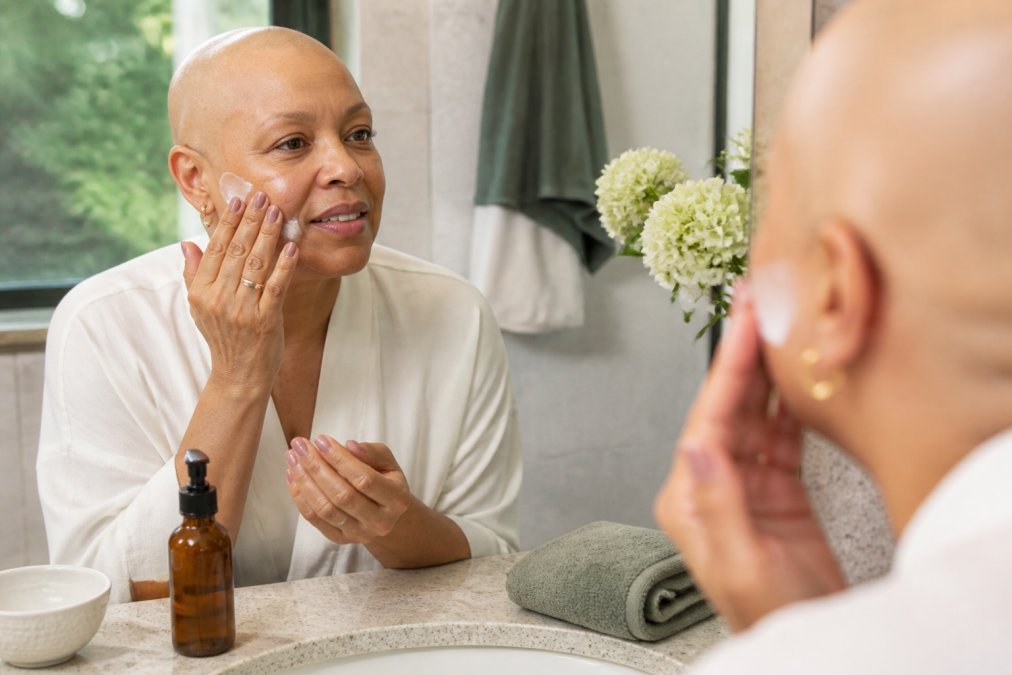
The core three steps
- Cleanse gently. Use lukewarm water and a mild, fragrance-free cleanser. Skip hot water and washcloths that tug.
- Moisturize while damp. Apply a fragrance-free moisturizer within a minute of cleansing to help lock in hydration.
- Protect. In the morning, finish with a broad-spectrum sunscreen of SPF 30 or higher on exposed skin.
At night, repeat steps one and two, and consider a richer cream to support the skin barrier overnight. Lotus Beauty Co.'s [Daily Ritual(/products/the-daily-ritual) | lotusbeautyco.com] pairs a lighter day cream with a richer night cream for exactly this rhythm, both fragrance-free and formulated with sensitive skin in mind.
Adjusting for your treatment type
Most routines are written as if all treatment is the same. It is not, and the differences matter.
A budget-conscious version
You do not need a premium regimen to care for your skin well during treatment. Many drugstore staples are fragrance-free, dye-free, and formulated for sensitive skin, and several are recommended by dermatologists for exactly this reason. Look for:
- A gentle, fragrance-free cleanser from the sensitive-skin aisle
- A plain ceramide or petrolatum-based moisturizing cream in a tub
- A mineral sunscreen with zinc oxide or titanium dioxide
Two habits that make it stick
Patch test any new product on your inner arm for a few days before using it on your face. And keep the routine in the same order every day, morning and night, so it becomes a small, familiar rhythm rather than one more decision to make.
When Your Reflection Feels Unfamiliar
Skin changes during treatment are not only physical. Many women describe a quiet grief when the face in the mirror does not match the one they know, and that feeling deserves to be named rather than pushed aside.
When to Call Your Oncology Team
Some skin changes are manageable at home. Others need a call, and knowing the difference protects you.
Contact your oncology or dermatology team if you notice:
- Skin that is broken, weeping, blistering, or bleeding
- Rapidly spreading redness, swelling, or warmth
- A rash that comes with fever or feels like it is worsening
- Severe itching or pain that disrupts sleep
- Any reaction after starting a new product
What You Notice |
What to Do |
When to Call |
|---|---|---|
Mild dryness or flaking |
Moisturize more often with a fragrance-free emollient |
If it worsens or cracks |
Redness in the treatment field |
Follow your radiation team's care instructions |
If it blisters, weeps, or spreads |
Itching without a rash |
Cool compress, fragrance-free moisturizer |
If it disrupts sleep or spreads |
New rash after a product |
Stop the product, patch test next time |
If it spreads, blisters, or comes with fever |
Frequently Asked Questions
What skincare should I avoid during chemotherapy?
Many oncology teams suggest pausing products with added fragrance, dyes, drying alcohols, and strong exfoliating acids while your skin is reactive. Retinoids and harsh scrubs are also commonly set aside during treatment. Check with your oncology or dermatology team before adding anything new, and look for fragrance-free, alcohol-free formulas with short ingredient lists. Lotus Beauty Co. publishes a full ingredient index so you can review every component before it touches your skin.
Is it safe to use fragrance-free products during radiation therapy?
Fragrance-free formulas are often recommended for skin in a radiation field because added fragrance is a common irritant. Your radiation oncology team may give you specific instructions for the treated area, and those instructions come first. Outside the treatment field, a gentle fragrance-free moisturizer and broad-spectrum sunscreen are usually reasonable. Always confirm with your care team before applying anything to irradiated skin.
How can I soothe dry and sensitive skin during cancer treatment?
Start with lukewarm, short showers and a mild, pH-balanced cleanser. Pat skin damp, then apply a fragrance-free moisturizer within a few minutes to support barrier function. Thicker emollient creams, like our Awaken Day Cream and Restore Night Cream, help with xerosis and everyday comfort. If you notice cracking, oozing, or spreading redness, contact your care team rather than layering on more product.
Should I consult my oncology team before changing my skincare routine?
Yes. Your oncology team knows your treatment type, stage, and any open skin issues, so they can flag ingredients or steps to avoid. Bring your current product list to your next appointment and ask about anything new, especially if you are in active radiation or infusion cycles. Lotus Beauty Co. products are dermatologist tested for irritation and sensitization, but individual needs still vary. Your care team should always have the final word.