
Gentle Skincare for Chemotherapy Patients: 2026 Guide
Table of Contents
- How Chemotherapy Changes Your Skin
- What You'll Need for a Gentle Chemotherapy Skincare Routine
- Step 1: Cleanse Gently, Without Stripping
- Fragrance Free Skincare for Sensitive Skin: Why It Matters
- Managing Skin Dryness During Chemotherapy
- Choosing an Oncology-Safe Moisturizer
- Sun Protection for Skin That's More Sensitive
- Makeup, Scalp Care, and Feeling Like Yourself
- Frequently Asked Questions
Last Updated: October 1, 2026
How Chemotherapy Changes Your Skin
Chemotherapy can leave skin dry, reactive, and easily irritated, and gentle skincare for chemotherapy patients starts with understanding why. Treatment affects fast-dividing cells, including the ones that keep your skin barrier strong. When that barrier weakens, moisture escapes and irritants get in more easily.
At Lotus Beauty Co., we hear this from women every week: skin that never used to flinch suddenly stings. That's not your imagination, and it isn't a sign you're doing something wrong.
Below, we'll walk through a simple routine you can start today, plus the ingredients worth avoiding and the ones worth keeping.
Why Sensitivity Increases During Treatment
Two things happen at once. Oil and water levels shift, so skin feels tight and rough. At the same time, the outer barrier thins, which means products that once felt fine can now cause stinging, redness, or itching.
Your care team is the right source for anything that looks severe. For everyday care, the fix is simpler than most people expect: fewer products, gentler ones, applied consistently.
Signs Your Skin Barrier Needs Extra Care
Watch for these signals:
- Tightness right after washing
- Stinging from products that never bothered you before
- Flaking, rough patches, or a dull look
- Redness or warmth that lingers
- Itching, especially after a shower
If several of these sound familiar, your routine needs to get quieter, not bigger.
What You'll Need for a Gentle Chemotherapy Skincare Routine
You need four things, and nothing more: a mild cleanser, a moisturizer, a mineral sunscreen, and patience. That's the whole list.
A common mistake is buying a full ten-step routine in a panic. Stressed skin does better with fewer steps. Each extra product is another chance for irritation, and it makes it harder to figure out what caused a reaction.
Here's the framework we suggest:
| Step | Product | When | Why It Matters |
|---|---|---|---|
| 1 | Gentle cleanser | Morning and night | Removes buildup without stripping |
| 2 | Moisturizer | After every cleanse | Supports the moisture barrier |
| 3 | Sunscreen | Every morning | Shields skin that's more sun-sensitive |
| 4 | Patch test | Before anything new | Catches reactions early |
A Simple Morning and Evening Order
Order matters more than the number of products. Apply thinnest to thickest, and give each layer a moment to settle before the next.
Morning
- Rinse or cleanse with lukewarm water. If your skin feels raw, a plain water rinse is enough on some days.
- Apply moisturizer while skin is still slightly damp.
- Wait about a minute.
- Apply mineral sunscreen as the last step, over the moisturizer rather than on bare skin.
Evening
- Cleanse gently to remove sunscreen and the day's buildup.
- Pat dry with a soft towel. Don't rub.
- Apply moisturizer while skin is still damp.
- On the driest spots, add a second thin layer two minutes later.
If your care team has prescribed a topical medication, ask them where it fits in this order. Many topicals go on clean skin before moisturizer, but the timing depends on the prescription, so let your team set that sequence.
How to Introduce a New Product Without a Setback
Introduce one product at a time, and give it about a week before adding anything else. That way, if a reaction shows up, you know exactly what caused it. Patch test first on your inner forearm for three nights. If there's no reaction, move to a small area along your jaw for two more nights before using it on your whole face.
What You Can Skip
You don't need exfoliants, retinoids, toners, essences, clay masks, or at-home peels while you're in active treatment unless your oncology or dermatology team specifically says otherwise. These steps are designed to speed up cell turnover or deep-clean, and skin in treatment is often already turning over faster than it can comfortably handle. A quiet routine isn't a compromise. It's the point.
Step 1: Cleanse Gently, Without Stripping
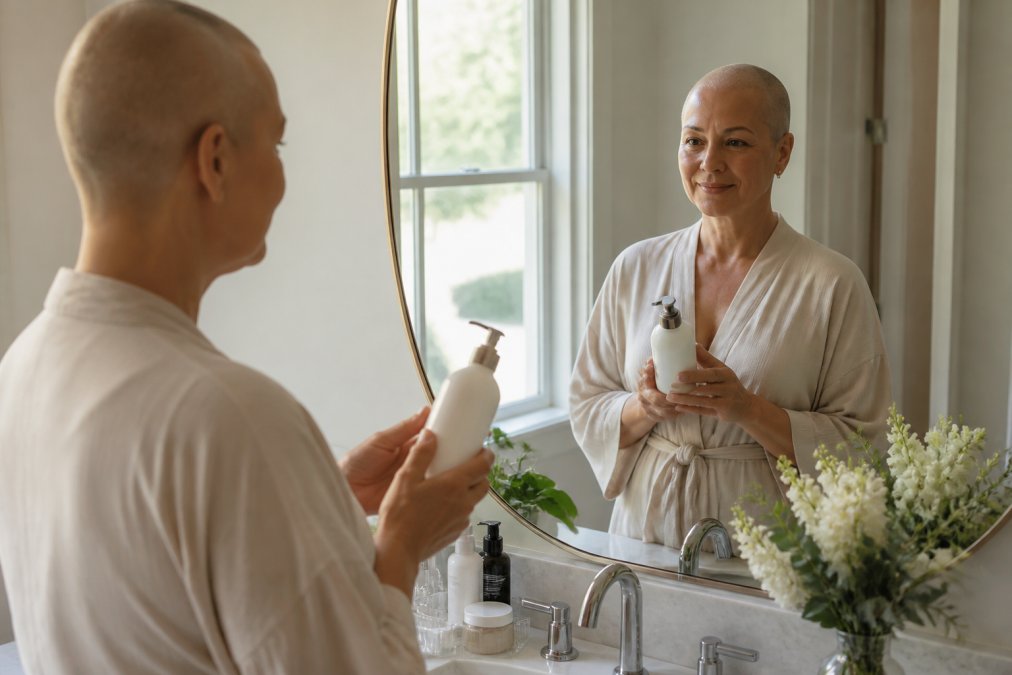
Wash with lukewarm water and your fingertips. Skip washcloths, brushes, and anything with texture. Use a mild, pH-balanced cleanser once in the morning and once at night, then pat dry instead of rubbing.
If your skin feels tight afterward, the cleanser is too strong or the water is too warm. Both are easy fixes.
Choosing a pH-Balanced, Sulfate-Free Cleanser
Look for a cleanser labeled sulfate-free and fragrance-free. Sulfates create lather, but that lather can leave skin feeling stripped. A pH-balanced formula sits closer to skin's natural range, which helps protect the moisture barrier while it cleans.
Cream or lotion cleansers tend to suit dry, reactive skin better than gels or foams. If a cleanser leaves a squeaky feeling, that's a sign to switch.
Fragrance Free Skincare for Sensitive Skin: Why It Matters
Fragrance is one of the most common causes of skin reactions, and it hides behind many names. "Parfum," "essential oil blend," and "natural fragrance" all count. For anyone in treatment, fragrance-free skincare for sensitive skin isn't a preference. It's the safer default.
Check the full ingredient list, not just the front label. A product can say "unscented" and still contain a masking fragrance.
Managing Skin Dryness During Chemotherapy
Managing skin dryness during chemotherapy comes down to timing: moisturize within a few minutes of washing, while skin is still slightly damp. That traps water instead of losing it.
Layering Moisture for Lasting Comfort
Try this order:
- Cleanse with lukewarm water and pat dry.
- Apply moisturizer while skin is still damp.
- Wait two minutes, then add a second thin layer on the driest spots.
- Reapply midday on hands, cheeks, and anywhere that feels tight.
Keep a small tube in your bag. Reapplying is the step most people skip, and it's the one that helps most.
Choosing an Oncology-Safe Moisturizer
An oncology-safe moisturizer is one made without fragrance, dyes, and common irritants, with a short, readable ingredient list. It should feel comfortable, not heavy, and it should be something you're willing to use twice a day.
Sun Protection for Skin That's More Sensitive
Skin in treatment is often more sensitive to sun, and some medications increase that further. A mineral sunscreen with zinc oxide or titanium dioxide tends to be the gentler choice for reactive skin.
Makeup, Scalp Care, and Feeling Like Yourself
Skin changes can affect more than comfort. Looking in the mirror and not recognizing yourself is its own kind of hard, and it deserves to be named rather than brushed past. Wanting to look like yourself is not vanity. It's identity, and it's allowed.
Makeup When Your Skin Is Reactive
The goal isn't full coverage. It's a little polish that feels like you, applied in a way that doesn't ask more of your skin than it can give right now.
Scalp Care During and After Hair Loss
The scalp is skin, and it goes through the same barrier changes as the face, often with less protection once hair thins. A few gentle habits make a real difference.
When to Stop and Call Your Team
If you'd like a starting point, our Lotus Beauty Co. Skincare is formulated with fragrance-free, sensitive-skin-friendly ingredients, and our guided by oncology and dermatology advisors. You can also check any ingredient in our Ingredient Index.
Frequently Asked Questions
What is the best skincare for chemo patients?
The best approach is simple and gentle: a fragrance-free, pH-balanced cleanser, a rich moisturizer, and daily sun protection. Look for products labeled hypoallergenic and non-comedogenic, and avoid anything with added fragrance, sulfates, or harsh exfoliants. A short routine you can actually keep up with matters more than a long one. Because skin can change week to week during treatment, check with your oncology or dermatology team before adding anything new.
What ingredients should I avoid in skincare during chemotherapy?
Skip added fragrance, sulfates, parabens, alcohol-heavy toners, and physical scrubs with rough particles. These can aggravate skin that is already more reactive. Also pause at-home chemical peels, retinoids, and strong exfoliating acids unless your dermatologist says otherwise. Patch testing a small area first, such as behind the ear, is a simple way to check how your skin responds before applying a product to your face.
How does chemotherapy affect skin sensitivity?
Chemotherapy can weaken the skin barrier, the outer layer that holds in moisture and keeps irritants out. That can lead to dryness, itching, redness, and a stinging sensation when products that used to feel fine are applied. Photosensitivity is also common, which is why daily sun protection matters. Because these changes vary by treatment and by person, your care team is the best source for what to expect in your specific situation.
How can I maintain a skincare routine when I feel fatigued?
Keep it to two or three steps and place products where you already are, like next to the sink or on your nightstand. A gentle cleanse, a moisturizer, and sunscreen in the morning cover the essentials. On low-energy days, a splash of lukewarm water and moisturizer is enough. A simple set like our Daily Ritual pairs a lightweight day cream with a richer night cream, so the routine is already decided for you.